Posting Payments is a big part of business and a big part of LOU. We’ve all had situations where we’ve had to return something as a consumer or accept a return as a business. The process for Posting a Refund is like Posting a Payment .
If you’re looking for information on voiding (deleting/cancelling) a payment instead of process a refund, check this out. Voiding a Payment is appropriate when you want to completely undo the Payment and delete the record. Voiding is handy when you made a mistake. On the other hand, a Refund leaves the original Payment record and creates a new record indicating the Payment was reversed. This is appropriate when the original Payment was valid, but there’s a reason to refund it.
Looking for how to post a refund in LOU Retail POS? Head here.
IMPORTANT! Refunds cannot be created without a corresponding Unapplied Balance. You must have a corresponding negative Invoice or other Unapplied Balance such as a Deposit to which the Refund can be applied to continue. See Sales Orders and Work Orders for information about creating Return Sales Orders and Work Orders which will create the Return (negative) Invoice.
Also keep in mind that if you choose Check as the Payment Method, you must print the check outside of LOU because the LOU Print Checks feature is only intended for AP Bills, not for Customer Refunds.
Go to Payments
- Click Create
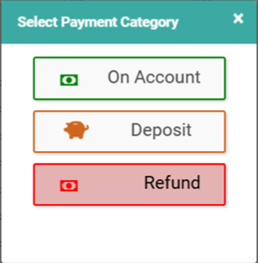
- Choose Refund
- Select Customer
- Select POS Station
- Optional Enter a Comment
- Enter the Dollar Amount to Refund
- Select Payment Method
- IMPORTANT! You should not create a Refund Payment for a credit card that was not charged the original sale amount. Merchant processors and credit card companies flag standalone refund payments as possible fraud. Be sure to process credit card refunds only back to the same card on which the original sale was charged or by cash, if the card is not available.
- In the Refunds box, the Amount entered will apply to the oldest Payment or Return Invoice first. This is reflected in the Amount Paid column.
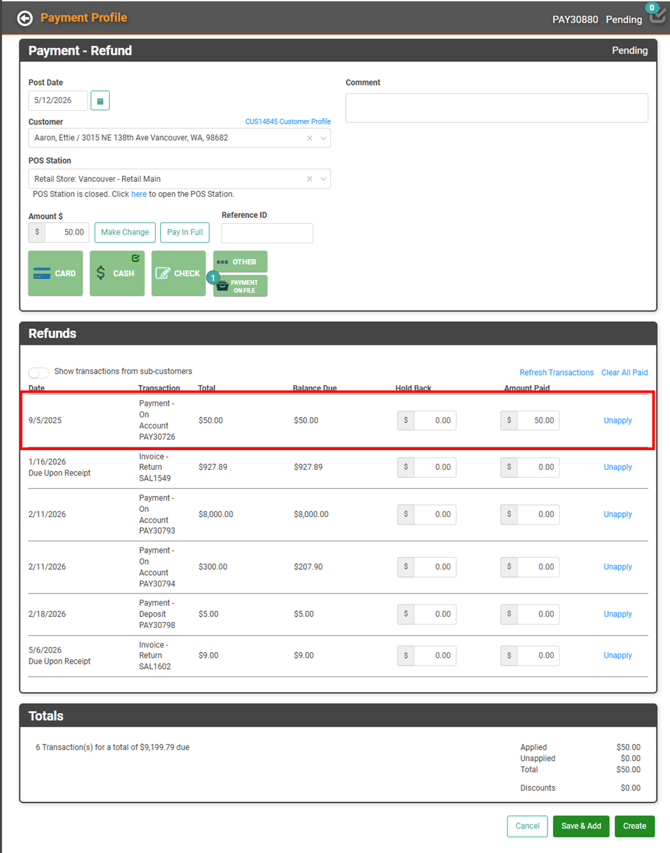
Restocking Fees and other charges that may reduce the refund amount owed can be entered in the Hold Back field. This will allow the Refund to apply to the Payment/Return Invoice while reducing the amount of money given to the Customer.
When a Refund is generated for an Amount greater than the oldest Payment/Return Invoice, LOU will automatically apply the Refund Amount to the oldest Payment/Return Invoice to the newest until the Refund Amount is fully applied.
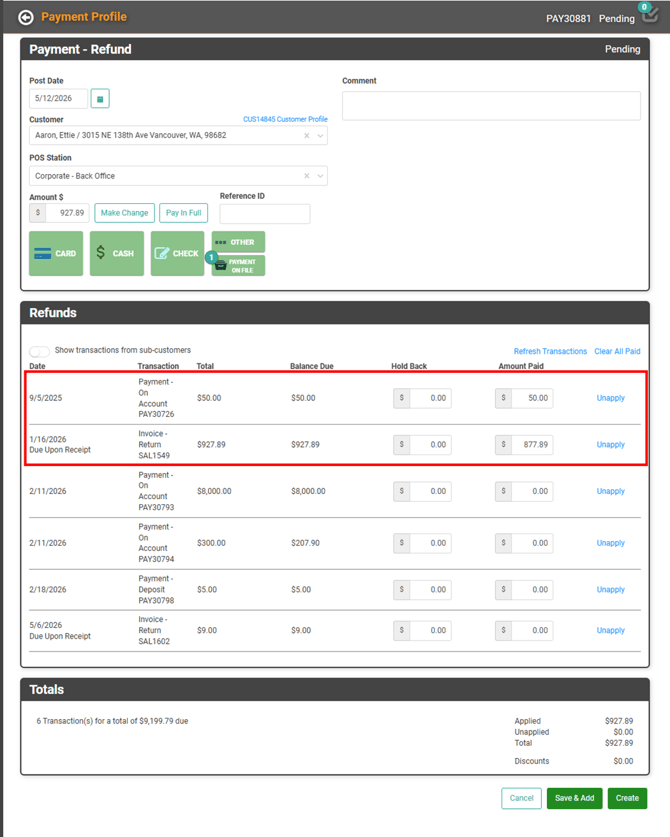
To apply the full Refund Amount to a specific Payment/Return Invoice, you can change the amounts in Amount Paid and click Unapply on the Payment/Return Invoice you don’t wish to be included. Additionally, you can use the Amount Paid fields to spread the Refund Amount across all Payments/Return Invoices listed.
9. Once the Refund Amount is allocated correctly, click Create to process the Refund Payment.
The Refund Payment will process and all associated documents will be updated appropriately.
Standalone Refund Payments
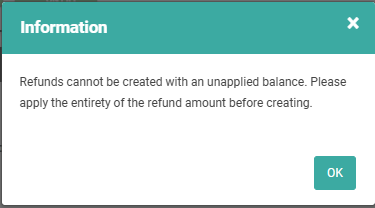
Refund Payments cannot be created without a corresponding Payment or Return Invoice. If you attempt to create a Refund Payment without applying it to a Payment/Return Invoice, you will get an error message.